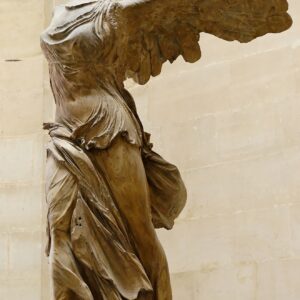
 The cult of the Great Gods or Cabiri has been of much interest for ancient, as well as modern seekers. The sanctuary of Samothrace lies in a secluded valley, away from curious eyes, between two creeks which, in ancient times, surrounded it. Immediately to the East lies the ancient city of Samothrace (Palaiopolis), once an ally of Athens in the Delian League. The site of the sanctuary has unveiled a well-known masterpiece, discovered here in the 19th century, which is the statue of Nike. It was probably erected before an ancient fountain and is now to be found in the Louvre Museum.
Herodotus maintained that the Mysteries of Samothrace were founded by the mythical Pelasgian people, about which few historical testimonies survive: “Whoever has been initiated into the rites of the Kabeiroi, which the Samothrakians learned from the Pelasgians and now practice, understands what my meaning is.” From this statement one can deduce that Herodotus himself was an initiate. Also, ceramic findings indicate the fact that a Thracian language was spoken on the island before the Greek colonization. In addition, a sacred non-Greek language is mentioned by Diodorus of Sicily, still existing in the 1st century BC. This is an important fact, as it shows that Greek initiates were using a sacred language, inherited from the founders of the Mysteries. Diodorus of Sicily also states that the Argonauts have dedicated sacred bowls which have been preserved in the sanctuary until his time:
“The Argonauts, they say, set forth from the Troad and arrived at Samothrake, where they again paid their vows to the Great Gods [the Kabeiroi] and dedicated in the sacred precinct the bowls which are preserved there even to this day.”[1]
Could perhaps these bowls represent the bowls described by Lucretius, which were used to demonstrate magnetic activity? The “iron rings” mentioned below were used, in general, so initiates could be recognized, and it is probable that they were magnetized, before being put on the finger.
“I have seen iron rings from Samothrace even leaping around and, at the same time, iron filings moving frantically inside bronze bowls, if one placed a stone of Magnesia underneath them.”[2]
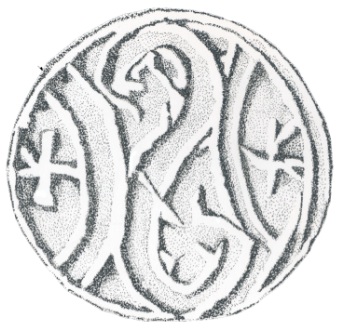 Magnetized iron rings were thus used for the recognition of initiates. I reproduced to the left the upper part of a ring discovered in Samothrace. The two stars (left and right) could represent the two Dioscuri (the twins Castor and Pollux), who were also among the Argonauts’ crew, and are often associated with the Mysteries of Samothrace.[3] Other initiate symbols include the purple fillets, worn around the waist by mystai, as we find in a Medieval scholia “So Odysseus is said to have used the veil [of Leucothea] in place of a fillet, sine he had been initiated in Samothrace – for the initiates bind purple fillets about their abdomen.”[4]
As in all ancient Mystery centres, the initiates were not allowed to publicly divulge the contests of the cult. A single source (Mnaseas of Patara) indicates the fact that the hidden names of the Cabiri were Axieros, Axiokersa, Axiokersos and Kadmillos.[5] Unsurprisingly, later Greek writers identified them with Demeter, Persephone, Hades and Hermes, probably due to an association with the better known Mysteries of Eleusis. Nevertheless, this syncretism may be viewed as a late addition to the cult.
[1] Diodorus Siculus, Library of History IV, 49.8.
[2] Lucretius, De Rerum Natura 6.1042 ff.
[3] After Orpheus prays to the gods to save the Argonauts, “immediately the wind died down and two stars fell over the heads of the Dioscuri [Castor and Pollux], and the whole company was amazed at the marvel which had taken place and concluded that they had been rescued from their perils by an act of providence of the gods. For this reason, the story of this reversal of fortune for the Argonauts has been handed down to succeeding generations, and sailors when caught in storms always direct their prayers to the deities of Samothrake and attribute the appearance of the two stars to the epiphany of the Dioscuri.” (Diodorus Siculus, Library of History IV, 43.1-2).
[4] Scholia Parisina to Apollonius Rhodius 1.918.
[5] It seems like a very fortunate event that these names were retained as, according to Strabo, they were kept secret. See Strabo, Geography, Book X, 3.21.
» Read further about The Sanctuary