In the Mystery centres of ancient Greece, the initiates were divided in mystai (who had taken part in the lesser Mysteries) and epoptai (who had been initiated in the greater Mysteries). There were no barriers for people of inferior social classes, slaves, women, or people with different ethnic origins, regarding the acceptance into the Mysteries – this fact was proved by numerous initiates’ lists discovered in the sanctuary. According to Plutarch, the parents of Alexander the Great, Philip and Olympias, have first met in their youth during their initiation in Samothrace.[1] It is nor surprising, therefore, that the Mysteries have become important for both Alexander the Great, and for his teacher, Aristotle. About this issue Rudolf Steiner mentioned:
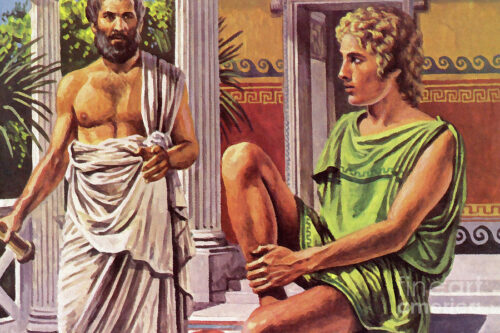
“When Alexander and Aristotle approached the Cabirian secrets in Samothrace at a time when the old Mysteries were already on the decline, something occurred to them at that moment through the influence of the Cabirian Mysteries like a memory of the old Ephesian time, which both had passed through in a certain century. And once more there resounded the I O A, and again they heard intoned:
World-engendered being, thou art shaped in light,
By the Sun empowered in the Moon’s full might;
Mars’ creating chiming, power to thee is bringing,
And Mercury, moving limbs in oscillation swinging;
Jupiter’s radiant wisdom is on thee gleaming,
And Venus’ love-bearing beauty is on thee beaming;
So that Saturn’s world-aged spirit-inwardness
Doth to space’s being and to ages now aborning consecrate thee! ”[2]
As these words remind us how the whole Macrocosm was felt by ancient initiates, it is perhaps worth reminding that they were pronounced in the most sacred moments, when the world opened before the spiritual eye. The Mysteries of the Cabiri had a particularity: to the outer world, not only the name, but also the form and activity fields of these gods were kept secret. But the initiating priest brought before the eyes of his disciples the vivid image of each of the Cabiri.
The Cabiri were venerated in other places as well (for instance, on Lemnos island and near the famous ancient city of Thebes). Although discoveries from these sites are older than those of Samothrace, few things link them together – besides the common name for the deities in historical documents. The reason is that we know very few facts due to the secret character that initiates were required to maintain, in order to be accepted in the Mysteries. Another island that lies close to Samothrace, Imbros, is at the same time another place where a sanctuary of the Cabiri existed. Although it hasn’t been found yet, it is known for the initiation of Pythagoras, the philosopher.[3]

Of course, much could be added about each sanctuary, but for our purpose here it is sufficient if we can admire the plasticity of the spiritual forms of ancient Greece, in comparison with those of today. The Mystery centres were places for obtaining a consciousness of the world, of inner transformation, and of maintaining spiritual life alive. By visiting these sanctuaries, one can even today feel the need for a pure, profound inner life, and we are urged to activity on the basis of the impulses of the Mysteries.
[1] Plutarch, Life of Alexander, chap. II, 1.
[2] Rudolf Steiner, Easter as a Chapter in the Mystery Wisdom of Man, GA 233a, Dornach, 22 April 1924.
[3] Iamblichus, Life of Pythagoras, chap. XXVIII, 151.
» Read further about Rudolf Steiner