First of all, this sanctuary is somewhat atypical, in respect to its location. Normally, cult buildings are placed in visible locations, near cliff tops, or close to the sea (as in the case of Eleusis). Although located on an island, the sanctuary of Samothrace was hidden in a valley, between two water streams which marked the sacred space, from the outer, profane space. Marked with the little red arrow is the forest where the sanctuary lies, to the North-West of the island.
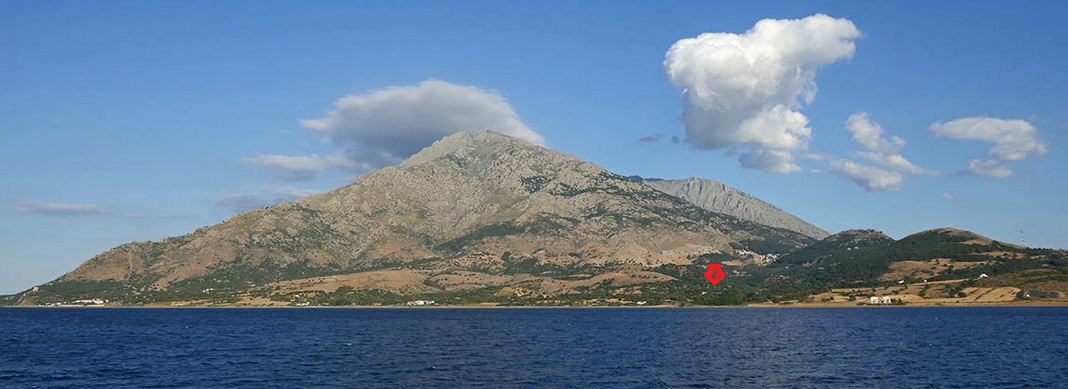
Secondly, the gods that were celebrated here were not of Greek origin, but probably Phrygian. The Greeks rarely had the habit (in contrast to the Romans) to adopt foreign divinities, so this is another issue worth mentioning. In the 1st century BC Diodorus Siculus actually refers to a secret language (maybe a Thracian dialect) spoken in the sanctuary of Samothrace.
Although ancient Greeks called them Kabeiroi (as Herodotus does, for instance), many initiates actually referred to these Gods as the „Great Gods” (Megaloi Theoi) as stone inscriptions prove. They were seen as saviours from perils at sea, as the island was surrounded by huge thunderstorms. In the myth of the Argonauts, Orpheus was an initiate of the Samothracian sanctuary and manages to save the ship by praying to the Great Gods and then coming to Samothrace to make offerings as gratitude to the gods.
Their names were probably secret, as they are mentioned only by one ancient source (Mnaseas of Patara) and were the following: Axieros, Axiokersos, Axiokersa, Kadmillos. All seem to be of foreign origin, and numerous pottery findings with Greek letters but in a different ancient language support the idea that a sacred cult language was used in the sanctuary.
Although findings in the necropolis are as late as 6th century BC, and Herodotus mentions the cult in the 5th century BC, all the main buildings of the site date to the 4th century BC or later, as you can see below:

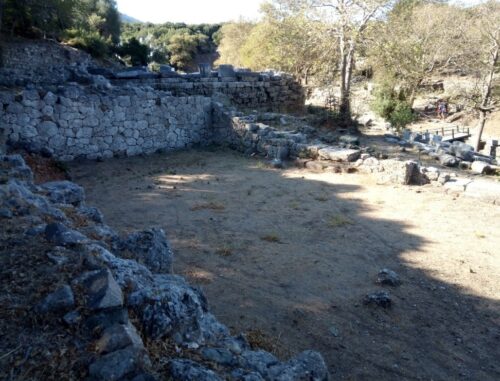
The entrance of the sanctuary was made from the route coming from the ancient city, going through a gatehouse (the Propylon, no. 26), then reaching the oldest datable structure (not actually a building, but a theatral circle, no. 25) where historian believe preliminary rituals and sacred oaths were being made.
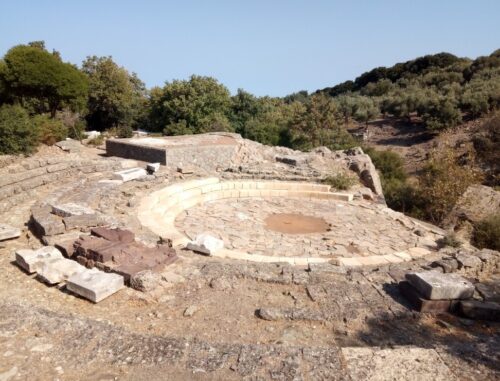
Going down the hill into the valley, one encounters the main cult buildings. All are datable from the time of Philip II of Macedonia onwards. It is known in history that Philip and his wife Olympias, mother of Alexander the Great, met during their initiation in Samothrace. There is no mention, however, of Alexander or Aristotle visiting the site, but might have happened during Alexander’s adolescence.
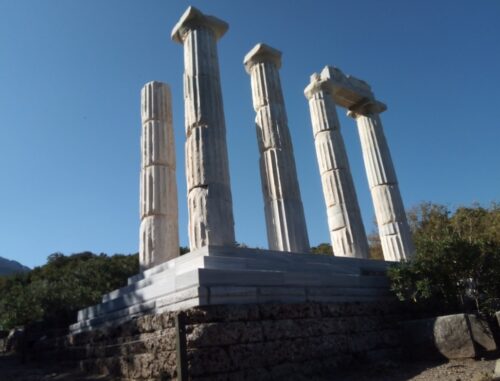
The main temple (the Hieron, no. 15) was built ca. 325 BC, so probably during Alexander’s campaigns in Asia. An inscription was found forbidding non-initiates to enter it.
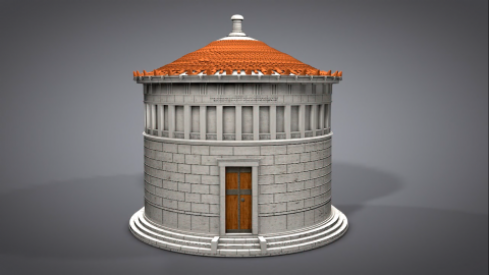
Later in the first decades of the 3rd century BC, according to an architrave inscription, queen Arsinoe II dedicated a great round building which we call the Rotonda (or the Arsinoeion, no. 20). This queen was probably an initiate and had a very tormenting life (first marrying the much older king Lysimachus, successor of Alexander in Macedonia, then after his death marrying king Ptolemy Keraunos in Egypt, who later murdered two of her sons, while she sought refuge in Samothrace).
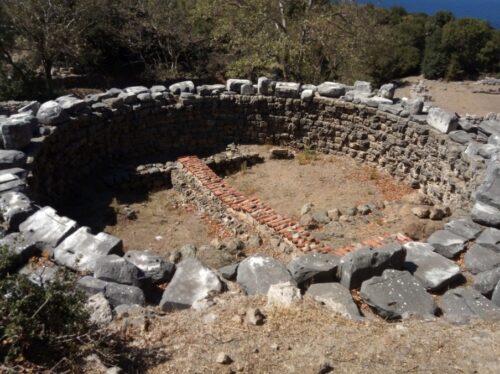
This is the only round building, and it was large enough to accommodate initiation ceremonies.
Much later, the Anaktoron (no. 23) was added to the North, and an inscription was found in Latin and Greek forbidding non-initiates to enter this building as well.
The famous statue of Nike of Samothrace was found outside the sacred space, in the Western area designated for habitation. In the sacred space there was however another rectangular building, called the Hall of Choral Dancers (no. 17), where a particular interesting frieze (in a very archaic style) has been discovered:
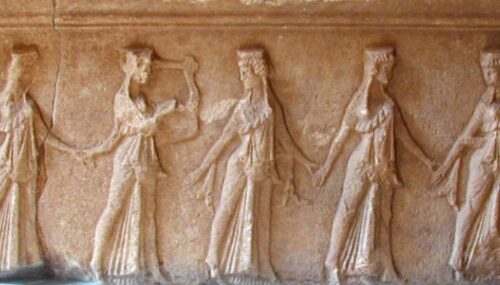
Some of the represented female dancers hold hands, while others play ancient instruments. The frieze was very large, surrounding the building on the inside. Its purpose has not been identified.
Historians argue which of these buildings was used for the first stage of initiation (myesis) and which for the second (epopteia). There was also a local myth about searching for Harmonia of Samothrace, the wife of Kadmos the hero (who brought the letters to Greece) but whether this was also part of the cult is not clear.
Altogether, ancient myths seem to indicate an origin of the sanctuary in the 2nd millennium BC, but there is no archaeological evidence to support this. It is clear that a monumentalizing project was started in the time of Philip II and they probably removed most of the old remains. Then the cult rapidly spread in the Aegean and at the Black Sea, where during Hellenistic times a lot of small buildings dedicated to the gods of Samothrace (one was typically called a Samothrakeion) have been established. These were often used to display public decrees of the polis. This is also a very peculiar aspect of this initiation cult (I don’t know any other example), to have had so numerous local associations in different cities, in order to support it.
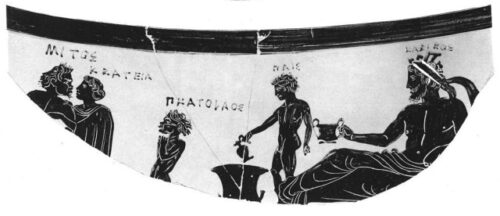
There were other big sanctuaries of the Cabiri, in the Northern Aegean (Lemnos and Imbros) and near Thebes. The cult seems to have varied a lot, as besides the common name of the gods, each had its own definite character. In Lemnos the Cabeiri were sons of Hephaestus (the whole island is very connected to the element of fire) while near Thebes they venerated only one Kabiros along with the ‘boy’ (Pais). This is the only known representation of them (right side):
» Read further about The Mysteries