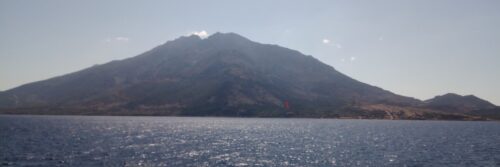
The Island of Samothrace lies in the Northern Aegean Sea and has been known from ancient times for the mystery cult of the Cabiri (gr. Kabeiroi). Although the island has been colonized by Greeks around 700 BC, the cult legends date back to the time of great heroes such as Kadmos of Tyr (known for bringing the alphabet from Phoenicia to Greece), Dardanos (colonizer of the area where later the city of Troy was founded) or Iasion (founder of the Mysteries of Samothrace). Also, in the great epic poem the Iliad we find the god Poseidon watching the Trojan war from the Phengari peak in Samothrace:
But the mighty Earth-shaker held no blind watch,
who sat and marvelled on the war and strife,
high on the topmost crest of wooded Samothrace,
for thence all Ida was plain to see;
and plain to see were the city of Priam,
and the ships of the Achaians.[1]
The island lies around some of the deepest, troubled waters of the sea, and near areas with steep promontories – a reason for which the Cabiri, or the Great Gods of Samothrace were known externally for saving navigators from perils at sea. Among well known initiates in these Mysteries the ancient authors include Orpheus, Agamemnon or Odysseus. The Argonauts in search of the Golden Fleece have also visited the sanctuaries of the Cabiri on the islands of Lemnos and Samothrace. During this journey, in the middle of an awful storm, they appeal to Orpheus, who was an initiate of the gods of Samothrace and who manages to stop the winds with his prayers: There came on a great storm [in the north Aegean] and the chieftains [the Argonauts] had given up hope of being saved, when Orpheus, they say, who was the only one on ship-board who had ever been initiated in the Mysteries of the deities of Samothrace (the Cabiri), offered to these deities prayers for their salvation.[2]
[1] Homer, Illiad, Book XIII, 9-14.
[2] Diodorus Siculus, Library of History IV, 43.1-2.
» Read further about The Cult